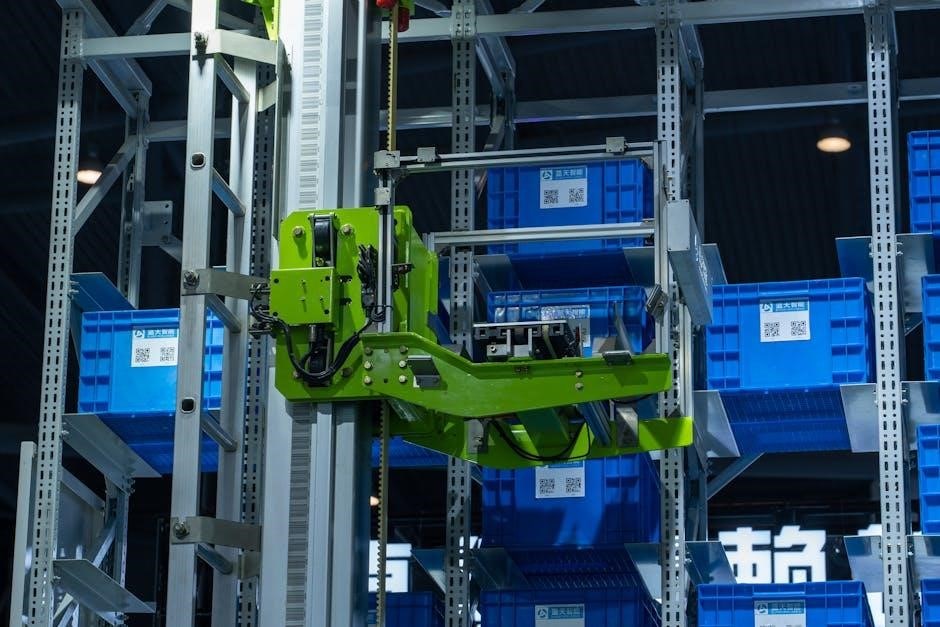
What Guides an AGV: A Comprehensive Overview
Automated Guided Vehicles (AGVs) utilize diverse guidance methods, including electromagnetic, magnetic stripe, laser, vision, and inertial systems, offering tailored solutions for facility needs.

AGV guidance systems are the core of their autonomous operation, dictating how they navigate environments without direct human control. These systems employ a variety of technologies, each with unique strengths and weaknesses, influencing suitability for specific applications. Historically, electromagnetic guidance and magnetic stripe navigation were prevalent, offering reliable, fixed-path solutions ideal for structured environments like warehouses.
However, modern AGVs increasingly leverage more sophisticated methods such as laser guidance, vision-based systems, and inertial guidance. These advancements enable greater flexibility, allowing AGVs to operate in dynamic environments and adapt to changing layouts. The selection of an appropriate guidance system is crucial, impacting factors like accuracy, cost, and integration complexity. Understanding these options is fundamental to successful AGV implementation.
Electromagnetic Guidance Technology
Electromagnetic guidance represents a foundational AGV navigation technique. It relies on a low-frequency radio signal emitted from a wire laid out on the facility floor, creating an invisible pathway for the AGV to follow. This wire acts as a guide, and the AGV uses sensors to detect the signal’s strength and direction, maintaining its course.

This method is known for its reliability and simplicity, particularly in stable environments. However, it requires physical infrastructure changes – installing the guiding wire – and offers limited flexibility. Altering the AGV’s path necessitates rewiring. It’s often used in material handling where fixed routes are sufficient, and is a key component in some AS/RS systems.
Magnetic Stripe Navigation
Magnetic stripe navigation employs a straightforward yet effective guidance method. AGVs follow a path defined by magnetic strips or tapes embedded in the floor. These strips emit a magnetic field detectable by sensors on the vehicle, directing its movement along the designated route. This system is relatively inexpensive to install, requiring only the application of the magnetic tape.
Like electromagnetic guidance, magnetic stripe navigation excels in predictable environments with fixed paths. However, it lacks the flexibility of more advanced systems. Any changes to the route require physically altering the magnetic strip layout. It’s commonly found in simpler AGV applications where precise, repeatable paths are paramount, and is often paired with automated guided vehicle systems.
Laser Guidance Systems
Laser guidance systems represent a significant step up in AGV navigation sophistication. These systems utilize rotating laser scanners mounted on the AGV to detect reflectors strategically positioned throughout the facility. By measuring the angle and distance to these reflectors, the AGV accurately determines its position and heading, enabling precise navigation without physical tracks.
This method offers a high degree of accuracy and is well-suited for complex layouts and dynamic environments. The precision makes it ideal for AS/RS (Automated Storage and Retrieval Systems) applications. While generally reliable, laser systems can be affected by obstructions or changes in the reflective surfaces, requiring careful maintenance and calibration to ensure optimal performance.
How Laser Navigation Works
Laser navigation functions by emitting a rotating laser beam that scans the surrounding environment. This beam bounces off strategically placed reflectors – often large, highly reflective targets – installed around the facility. The AGV’s onboard computer precisely measures the time it takes for the laser light to return, calculating the distance to each reflector.
By triangulating these distances and angles to multiple reflectors, the AGV determines its precise location and orientation within the workspace. This process happens continuously, allowing the AGV to dynamically adjust its path and avoid obstacles. The system relies on a pre-mapped layout of reflector positions for accurate positioning and efficient route following.
Advantages of Laser Guidance

Laser guidance offers significant advantages, primarily its exceptional precision and reliability, making it ideal for applications demanding accurate positioning, such as Automated Storage and Retrieval Systems (ASRS). This method allows AGVs to navigate complex environments with fixed routes efficiently.

Furthermore, laser guidance is relatively unaffected by environmental factors like floor conditions or lighting changes, ensuring consistent performance. While optical systems generally require more maintenance than some alternatives, the benefits of accuracy often outweigh this consideration. The ability to tailor AGVs with laser guidance to specific facility layouts provides a flexible and robust solution.
Vision-Based Guidance Technology
Vision-based guidance represents a sophisticated approach to AGV navigation, employing cameras and image processing to perceive and interpret the surrounding environment. This technology encompasses several techniques, including natural feature navigation, where the AGV identifies and tracks pre-existing landmarks within the facility.
Another prominent method is QR code/two-dimensional code guidance, utilizing strategically placed codes for positional awareness. These systems offer flexibility and adaptability, reducing reliance on fixed infrastructure. Vision systems are increasingly popular due to their cost-effectiveness and ability to handle dynamic environments, though performance can be affected by lighting conditions.

Natural Feature Navigation
Natural Feature Navigation empowers AGVs to operate autonomously by recognizing and utilizing pre-existing elements within a facility – walls, columns, equipment, and other static objects. This method eliminates the need for installing dedicated guidance infrastructure like magnetic strips or reflectors, reducing initial costs and installation time.

The AGV’s onboard camera captures images, and sophisticated algorithms identify and track these natural features, determining its position and orientation. While offering flexibility, this approach demands robust image processing capabilities and can be sensitive to changes in the environment, such as moved objects or altered lighting conditions.
QR Code/Two-Dimensional Code Guidance
QR Code and Two-Dimensional Code Guidance represents a cost-effective and relatively simple AGV navigation technique. This method involves strategically placing these codes on the floor, defining the AGV’s path. An onboard camera scans these codes, allowing the vehicle to determine its location and follow the designated route.
This system is particularly well-suited for facilities requiring frequent path adjustments or those with limited budgets. However, it relies heavily on the consistent readability of the codes – damage, obstruction, or poor lighting can disrupt navigation. Regular maintenance and code replacement are essential for reliable operation.
Inertial Guidance Systems
Inertial Guidance Systems offer AGVs a degree of autonomy by relying on internal sensors to track position and orientation. These systems primarily utilize gyroscopes to detect even the smallest changes in the vehicle’s direction, enabling continuous course correction without external references. This is particularly useful in environments where other guidance methods might be unreliable.
However, inertial systems are prone to drift over time, accumulating errors that can lead to inaccuracies. To mitigate this, many implementations incorporate transponder-based confirmation. These transponders, embedded in the floor, provide periodic checkpoints for the AGV to recalibrate its position, ensuring continued accuracy.
The Role of Gyroscopes
Gyroscopes are fundamental components within inertial guidance systems, acting as the ‘sense of direction’ for AGVs. These sensors meticulously detect even minuscule alterations in the vehicle’s angular velocity, effectively monitoring any change in orientation. This capability allows the AGV to maintain its intended path without constant reliance on external cues like magnetic strips or laser reflectors.
By continuously measuring these directional shifts, gyroscopes enable the AGV’s control system to proactively correct its course, preventing deviations and ensuring precise navigation. A gyroscope can detect the smallest change in the vehicles direction and correct it, contributing to smooth and accurate movement.
Transponder-Based Confirmation
Transponder-based confirmation serves as a crucial verification step within inertial guidance systems. Strategically embedded within the AGV’s operational environment – typically the floor – these transponders act as checkpoints along the designated route. As the AGV passes over these transponders, it transmits a signal, allowing the vehicle to confirm its precise location and heading.
This confirmation process effectively mitigates the cumulative errors inherent in inertial navigation, ensuring the AGV remains accurately on course. The AGV uses transponders embedded in the workplace floor to confirm that the vehicle is on course, enhancing overall system reliability and navigational precision.
Hybrid Guidance Systems
Hybrid guidance systems represent a sophisticated approach to AGV navigation, combining the strengths of multiple technologies to overcome individual limitations. A common example involves integrating laser guidance with vision-based systems. Laser guidance provides high precision for initial route following, while vision systems offer adaptability to dynamic environments and obstacle avoidance.
Furthermore, integrating inertial sensors with other methods enhances accuracy and robustness. This combination leverages the short-term precision of inertial measurement units (IMUs) with the long-term accuracy of laser or vision systems, resulting in a highly reliable and versatile AGV solution.
Combining Laser and Vision
Combining laser guidance and vision systems creates a robust AGV navigation solution, capitalizing on each technology’s strengths. Laser scanners excel at precise path following by detecting strategically placed reflectors within a facility, ensuring high accuracy along fixed routes. However, lasers can struggle with dynamic changes.
Vision systems address this limitation by providing environmental awareness and obstacle detection. They allow the AGV to adapt to unexpected changes, navigate around obstructions, and even recognize specific features for localization. This synergy results in an AGV capable of both precise, repeatable movements and flexible, responsive navigation.
Integrating Inertial Sensors
Inertial guidance systems, utilizing gyroscopes, play a crucial role in maintaining AGV orientation and tracking movement, even during brief interruptions of other guidance signals. Gyroscopes detect even minute changes in the vehicle’s direction, enabling continuous course correction and preventing drift. However, inertial systems alone accumulate errors over time.
To mitigate this, AGVs often integrate inertial sensors with other guidance methods, like laser or vision. Transponders embedded in the floor provide periodic positional confirmation, resetting the inertial system’s accumulated error and ensuring long-term accuracy. This hybrid approach delivers a highly reliable and precise navigation solution.
Considerations for Choosing a Guidance Method
Selecting the optimal AGV guidance method demands careful evaluation of specific operational needs. Accuracy and reliability are paramount; systems like laser and magnetic navigation excel in applications requiring precise, repeatable paths, such as within Automated Storage and Retrieval Systems (ASRS). Conversely, optical systems offer greater flexibility.
Facility infrastructure significantly influences the choice. Existing layouts may favor magnetic stripe navigation, while facilities lacking fixed infrastructure benefit from laser or vision-based solutions. Cost is also critical, encompassing initial investment and ongoing maintenance. A thorough assessment of these factors ensures a successful AGV implementation.
Accuracy and Reliability Requirements
Defining accuracy and reliability needs is crucial when selecting an AGV guidance system. Applications demanding pinpoint precision, like those within ASRS or fixed-route material handling, benefit from laser and magnetic navigation methods. These technologies consistently deliver high accuracy and dependable performance.
However, if operational flexibility is prioritized, vision-based systems offer an alternative, though potentially requiring increased maintenance to sustain accuracy. The level of acceptable deviation and the consequences of errors directly dictate the necessary system robustness. Careful consideration of these factors ensures optimal AGV performance.
Facility Infrastructure and Layout
Existing facility infrastructure significantly influences AGV guidance system selection. Magnetic stripe navigation necessitates the installation of wires within the floor, a considerable undertaking for existing facilities. Conversely, laser guidance relies on strategically placed reflectors, offering a less invasive implementation.
Vision-based systems, including QR code guidance and natural feature navigation, adapt well to dynamic environments but require clear visibility. Complex layouts may favor inertial guidance supplemented by transponders for course correction. Ultimately, the layout dictates the feasibility and cost-effectiveness of each guidance method.
Cost Analysis of Different Guidance Methods
Initial investment costs vary greatly between AGV guidance systems. Magnetic stripe navigation and electromagnetic guidance require substantial upfront expenses for wiring installation. Laser guidance involves reflector placement, a moderate cost. Vision-based systems, utilizing QR codes, are relatively inexpensive to implement initially.
Maintenance and operational costs also differ. Optical systems may demand more frequent maintenance than laser or magnetic approaches. Inertial guidance, while precise, can be costly to calibrate. A thorough cost analysis, considering both initial outlay and long-term expenses, is crucial for informed decision-making.
Initial Investment Costs
Laser guidance systems necessitate investment in laser scanners and strategically positioned reflectors throughout the facility, representing a moderate upfront expenditure. Magnetic stripe navigation and electromagnetic guidance demand significant initial costs due to the installation of guiding wires or magnetic tracks embedded in the floor.
Conversely, QR code/two-dimensional code guidance offers a lower initial investment, primarily requiring the printing and placement of codes. Vision-based guidance, relying on natural features, minimizes initial hardware costs, but may require more complex software development. Careful consideration of these varying costs is vital for budget allocation.
Maintenance and Operational Costs
Laser guidance systems require periodic cleaning and calibration of laser scanners and reflectors to maintain accuracy, contributing to ongoing maintenance expenses. Magnetic stripe navigation and electromagnetic guidance involve potential costs for repairing or replacing damaged wires or tracks.

Vision-based guidance may necessitate frequent software updates and recalibration to adapt to environmental changes. QR code guidance demands regular inspection and replacement of potentially damaged or obscured codes. Inertial guidance systems, while generally low-maintenance, require occasional gyroscope calibration. Operational costs also include energy consumption and potential downtime for repairs.
Future Trends in AGV Guidance
Advancements in LiDAR technology, particularly solid-state LiDAR, promise more affordable, reliable, and compact AGV guidance solutions. The increasing adoption of Simultaneous Localization and Mapping (SLAM) enables AGVs to navigate dynamically without fixed infrastructure, offering greater flexibility.
Expect further integration of artificial intelligence (AI) and machine learning (ML) to enhance obstacle avoidance and path planning. Hybrid systems combining multiple guidance methods – like laser and vision – will become more prevalent, maximizing robustness. Development focuses on reducing reliance on external infrastructure and improving AGV autonomy in complex environments.
Advancements in LiDAR Technology
LiDAR (Light Detection and Ranging) is rapidly evolving, with solid-state LiDAR emerging as a key advancement for AGV guidance. These sensors offer improved reliability, reduced size, and lower costs compared to traditional mechanical LiDARs. This technology provides high-resolution 3D mapping, enabling precise navigation and obstacle detection.
Further developments focus on increasing LiDAR’s range and field of view, enhancing performance in challenging environments. Integration with AI algorithms allows for more intelligent data processing and improved situational awareness for AGVs, ultimately leading to safer and more efficient operation within dynamic facilities.
The Rise of Simultaneous Localization and Mapping (SLAM)
SLAM (Simultaneous Localization and Mapping) represents a significant leap in AGV guidance technology, allowing vehicles to build a map of their environment while simultaneously determining their location within it – without relying on pre-existing infrastructure. This is achieved through sensor data, often combined with LiDAR or vision systems.
SLAM empowers AGVs to navigate complex and changing environments dynamically, adapting to obstacles and alterations in the facility layout. This capability reduces the need for costly and time-consuming infrastructure installations, offering greater flexibility and scalability for automated material handling solutions;
Safety Features in AGV Guidance Systems
AGV guidance systems prioritize safety through multiple integrated features. Emergency stop mechanisms are crucial, allowing immediate halting of the vehicle in response to detected hazards or manual activation. Equally important is obstacle detection and avoidance, utilizing sensors like lasers or cameras to identify and navigate around obstructions in the AGV’s path.
Modern systems often incorporate safety-rated monitoring modules, ensuring reliable performance of safety functions. These features minimize the risk of collisions, protect personnel, and safeguard infrastructure, creating a secure and efficient automated environment. Robust safety protocols are paramount for successful AGV deployment.
Emergency Stop Mechanisms
Emergency stop (E-Stop) mechanisms are fundamental safety components within AGV guidance systems. These systems enable immediate cessation of vehicle operation when a hazardous situation is detected or manually triggered. Typically, E-Stops involve readily accessible buttons on the AGV itself and strategically placed remote stations along the defined routes.
Upon activation, the E-Stop initiates a controlled deceleration, bringing the AGV to a complete halt. Modern AGVs often feature redundant E-Stop circuits for enhanced reliability. These mechanisms are critical for preventing collisions, protecting personnel, and mitigating potential damage within the automated environment, ensuring a swift and secure response to unforeseen events.
Obstacle Detection and Avoidance
Obstacle detection and avoidance are crucial features integrated into AGV guidance systems, enhancing operational safety and efficiency. AGVs employ various sensor technologies – including lasers, vision systems, and ultrasonic sensors – to perceive their surroundings and identify potential obstructions in their path.

Upon detecting an obstacle, the AGV’s control system initiates an avoidance maneuver, either by stopping, re-routing, or slowing down. Sophisticated algorithms enable the AGV to navigate around the obstacle safely and resume its intended route. This capability minimizes disruptions, prevents collisions, and ensures continuous material flow within the facility, contributing to a more dynamic and responsive automated system.